


-
Power dispatch planning in renewable energy is the operational process of scheduling and controlling generating units to meet electricity demand while managing the variability of sources like wind and solar.
-
Typical renewable generation includes solar (PV, CSP) and wind.
-
Since renewable sources of power have a lower capacity factor, various measures for alternate power generation like a natural gas turbine, fuel cells or diesel generators can be used to offset the variation in power generation.
-
Long-term energy storage (10+ hours) plays a key role in power dispatch planning. A few examples of storage include batteries, CO2, molten salt and supercapacitors.
Introduction
Traditional dispatch assumes controllable generation (coal, gas, hydro).
Solar and wind are the dominant forces in renewable energy growth, with solar often leading in new capacity additions, while wind often contributes a larger share to current electricity generation. In this article, we will be specifically focused on the solar form of energy generation, as it is one of the fastest growing segments under renewable energy.
Renewables introduce:
- Intermittency (solar & wind depend on weather)
- Uncertainty (forecast errors)
- Low marginal cost (near-zero fuel cost)
- Grid constraints (ramping, reserves, congestion)
So renewable power dispatch planning must balance reliability, cost, emissions and grid stability.
Role of Energy Storage in Dispatch
Storage enables:
- Smoothing renewable output
- Peak shaving
- Frequency regulation
- Energy arbitrage
Dispatch decisions include:
- Charge/discharge duration
- State of charge (SOC) limits (for batteries)
- Degradation costs (degradation of batteries is more prevalent than molten salt or CO2)
As shown in Figure 1 below, different combinations can be used for power generation and storage based on the following factors.
Project Size (MW Rating)
This plays a key role in selecting generation and storage technologies. For smaller size projects (less than 5 MW), PV will be more economical compared to CSP. Similarly, Li-ion battery or supercapacitor can be more economical as storage solution.
Land Area
The size of land available for project development will decide the power generation and storage technology, CO2 requires larger land area compared to other storage technologies.
Storage Capacity (Hours)
Like project size, duration decides energy storage technology. For longer-term energy storage (more than 6 hours), CO2 or molten salt can be more viable offering than batteries.
|
Battery Type |
Duration |
Remarks |
|
Lead-Acid |
Less than 2 hours |
Typically used in UPS. Lower cost, but have degradation issues |
|
Lithium-ion |
Can be used up to 6 hours |
Expensive compared to lead acid but have better design life up to 10 years |
|
Flow Batteries (e.g., Vanadium Redox) |
10+ hours |
No degradation issues, but limited installed project experience |
|
CO2 |
10+ hours
|
No degradation issues, but limited installed project experience |
|
Molten salt (charged/heated using CSP) |
10+ hours
|
No degradation issues |
Permit Requirements
Evaluation needs to be done in terms of emission, sometimes using fuel cells is more beneficial compared to a natural gas turbine to meet Title V permits.
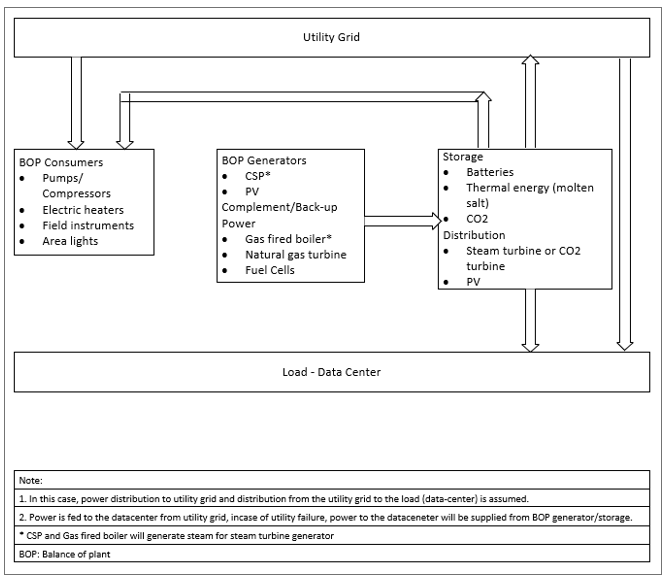
Figure 1
Results and Observations
Renewable Generation
PV is a more prevalent form of renewable generation compared to CSP. Furthermore, the supply chain is fairly established in the PV space, giving an advantage of shorter lead time and installation cost.
Back-Up Power
As solar generation technologies depend on weather, it is not possible to get nameplate power all the time. To compliment the loss of generation due to weather, fuel cells or natural gas turbines are preferred where natural gas is readily available. Diesel generators are also very common for back-up power.
Long-Term Energy Storage
While batteries are a very common form of short-term energy storage within the PV field, new alternatives are being explored for longer duration storage. With traditional lithium batteries, there is an issue with degradation and limited design life of 10-15 years. In such cases, molten salt, CO2 or flow batteries may be more economical over the project design life.
Conclusion
- Solar field (PV or CSP) will generate power during the daytime. The excess power generated is used to charge the energy storage system. This stored power can be used during the nighttime.
- Dispatch planning is the brain of the grid, ensuring clean, cheap and reliable power flows from variable sources to consumers efficiently.